


RIDING ON INCREASING DEMAND
ACCELL’S HUNGARIAN SUBSIDIARY PRODUCES EUROPE’S TOP BIKES
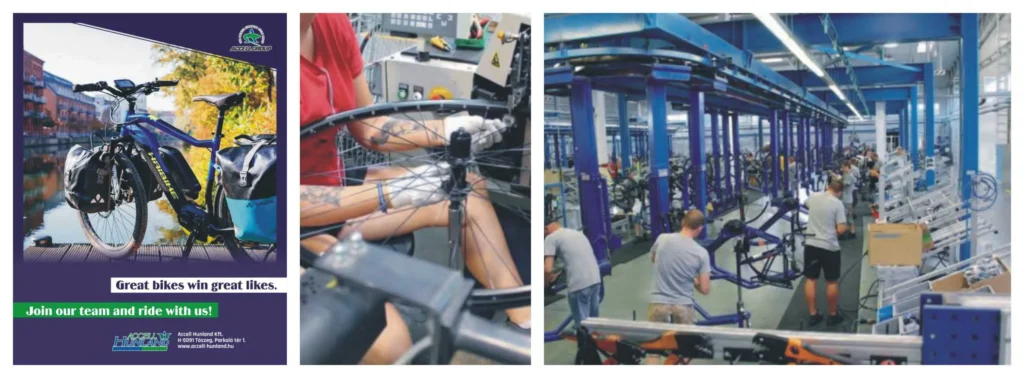
The small Hungarian village of Tószeg near Szolnok is a rather unusual location for a bike manufacturing plant that produces some of Europe’s most sought-after two-wheelers. Yet, it is exactly here that Accell Hunland Ltd., a unit of the Dutch Accell
Group, started operations in 2001 as a greenfield project. The annual production capacity is 300,000 mid and high-end bicycles and, especially in reeent years, e-bikes.
“In the early 2000s, when Accell Hunland started its operations, traditional bikes were in demand — mostly on the German market. Since then, the bike industry has gone through a huge transformation. The biggest leap happened in 2009 with the introduction of electric bikes, which spearheaded the increase in demand for the factory’s products, a demand that has been growing by 15-20% a year in the last couple of years,” Attila Vass, Managing Director of Accell Hunland Ltd. says.
High-quality products
Accell Hunland’s main focus gradually shifted from the German market to most of the Western European countries. It began to produce almost all major brands including Winora, Ghost, Lapierre, Haibike and Raleigh. Some of these are high-end bikes, like the Haibike Xduro AllMtn 3.0. “We are part of Accell Group, which is one of the market leaders in the medium and high—end bike market in Europe, so we are taking quality very seriously. Of course, cost is also an important aspect of our operation, so we are focusing on continuously improving productivity,” Vass adds.
Why need a new bike?
The executive points out that the bike industry has undergone tremendous change, not only because of the appearance of electric bikes, but because there has been a sharp increase in demand for mountain bikes, trekking bikes and other specific categories. Materials and design innovations have led to bikes becoming more and more lightweight, and the different brake solutions have made bikes safer to use. “And let’s not forget connectivity, which is a call word in our industry as well.
” Consumers’ focus has also shifted to more personalization and expression of self. People want to change their bikes not only because of a new feature or lighter weight, but also to have a frame in a different shape or color.
Innovation
Maintaining and improving market position among electric bike manufacturers requires agility and constant innovation. Vass highlights that Accell Group is famous for its innovations in the bike industry and „we were one of the first producers to step into the electric bike market. Our Innovation and Technological Centers (I&T) are located in Germany, France and the Netherlands.
They are providing us with cutting—edge designs for the new bikes and they are implementing new and innovative bike components for our new products. The factory’s responsibility is to provide information to the designers on the best solutions for assembly. Design For Manufacturing (DFM) is becoming more and more important to meet our high quality and productivity standards.”
Managing the workforce
Recruiting and retaining the labor force has become a serious issue for manufacturing companies operating in Hungary. Attila Vass agrees, saying that available labor is one of their major issues. “One of the most important things for us is to provide our colleagues with a workplace where they feel good and know that they are valued. We believe in the importance of the information flow upwards and downwards, which means that besides a competitive compensation package, we work to improve our workplace environment inside and outside of the building. We would like to create a comfortable workplace.” He adds that seasonality requires heightened flexibility on the part of the company due to the huge difference in demand between the first and the second half of the year. „Therefore, we use temporary workers for 6—7 months of a year. We have also started to cooperate with other companies having different peak seasons to manage the work force demand.”
Sustainability and social responsibility
As climate change and environment protection increasingly take center stage in public discourse, the use of bicycles is increasingly regarded not only as a healthy means of transport but also a way to care for the environment. The executive stresses that sustainability is a key consideration in the new product innovation process and in manufacturing as well. “In order to reduce our manufacturing footprint, we have introduced led lighting in our buildings, and we operate selective waste collection. We have also been improving our painting technology continuously. As a next step, we have looked into the use of solar cells to provide the electricity needed for manucafturing. Accell Hunland has recently donated some of its products to a welfare institute. This move has been part of the social responsibility policy of Accell Group to support local goverments and communities in their activities connected to environmental issues or sport activities,” he adds.
ACCELL GROUP
Accell Group focuses on the mid—range and higher segments of the bicycle market as well as bicycle parts and accessories. It is the European market leader in e-bikes and Europe’s second biggest producer of bicycle parts and accessories. Its bicycles and related products are sold to dealers and consumers in more than 80 countries worldwide. Well-known bicycle brands In the Accell Group portfolio Include Babboe, Batavus, Ghost, Haibike, Koga, Lapierre, Raleigh, Sparta and Winora. XLC is the brand for bicycle parts and accessories. Accell Group employs approximately 3.300 people across 18 countries. In 2018, it sold around 1.1 million bicycles and recorded a turnover of over EUR 1 billion.
https://issuu.com/diplomacytrade/docs/2019_dt_sept
II. Accell Hunland Jótékonysági Futóverseny 2024.
április 10, 2024
szeptember 18, 2023
Átadták a Prima Primissima díjakat
szeptember 18, 2023
Kerékpárt ajándékoztunk az Év Diákjának
augusztus 30, 2023
Visszaélés történt cégünk nevével
augusztus 8, 2023